
Libre is a sensor that continuously measures your interstitial glucose (interstitial being the fluid between the cells in your flesh). This means it can be described as a Continuous Glucose Monitor (CGM). Libre performs the glucose measurement once a minute and stores fifteen minutes worth of such one minute data. This data is stored in a circular buffer so that when the buffer is full the next data item overwrites the oldest item. This means that there will always be the last 15 readings in memory and when you scan the last value will be displayed on the reader.
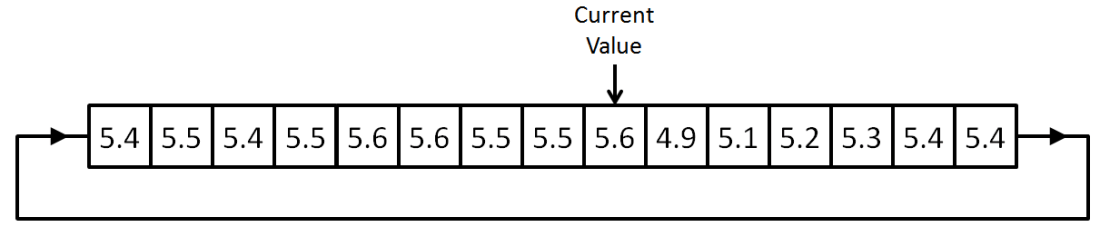
Every fifteen minutes the sensor averages the one minute data and stores that average. The sensor can store up to 32 of the fifteen minute data, again, in a circular buffer. This means that the sensor will have the last 8 hours of fifteen minute data. All of this data, the one minute data for the last fifteen minutes and the last eight hours of fifteen minute data, is downloaded to the Libre reader (or a suitable phone) when the sensor is “swiped”.
Flash or Real Time?
Although the sensor continuously monitors glucose, the reader (and hence the user) only obtains the data when they swipe the sensor. For this reason the device is known as “flash CGM”. More recently the term “iCGM” has been used, where the “i” stands for “intermittently”. This is to identify it as different to other types of CGM which are typically called “rtCGM” for “real time” CGM.
CCGs typically use the fact that Libre is flash as a reason not to prescribe it. This fundamentally misunderstands the device. A real time CGM transmits the measured value to the reader at the time of measurement. For a diligent diabetic this makes little difference because they will be scanning their Libre, or looking at the rtCGM reader, regularly, and the effect will be the same.
Where rtCGM are helpful is during the times when it is not possible to scan regularly, in particular, when you are asleep. The rtCGM readers typically have alarms that sound when particular glucose targets are hit, in particular, when glucose levels are going low. Night time hypos are very dangerous because they are severe. An alarm will warn the diabetic that they are going hypo and they can take action to alleviate the symptoms (alleviate because the diabetic will still be hypo until the glucose they take has effect, which could be 30 minutes). For someone whose diabetes is uncontrollable, an rtCGM is an important device. However, for most diabetics it is better to eliminate the causes of night time hypos, and for this, Libre is a relatively cost-effective device.
Notice the term in the last paragraph “glucose levels are going low“. Because a CGM has continuous glucose measurements it means that trends can be deduced. So if the fifteen one minute values are consecutively decreasing, it is likely that glucose will continue to decrease at a similar rate. Libre has alarms that warn you that your glucose is falling when you are close to hypo level.
Another feature of rtCGM is calibration. This is not specific to the real time aspect of rtCGMs, just that the current rtCGM require the user to regularly calibrate the sensor to blood stick tests. Abbott claim that their sensors are calibrated in the factory and they do not need re-calibration during their fourteen day use. This should be regarded as a positive feature, but some people will insist (without evidence) that it isn’t. Remember when no-coding blood sticks were introduced? That was a great feature and no one complained about it. So why should no calibration of Libre be regarded as being a problem?
Why Use Libre?
The most irritating aspect of Abbott’s marketing for Libre is their obsession that it removes the requirement to do finger prick blood capillary tests. A type 1 diabetic will be injecting at least 4 times a day, and since Libre makes it more effective to do correction doses, using the system may even increase the number of injections they do. So is it really a good marketing message to say that Libre reduces finger pricking? Its quite clear that reduced finger pricking does not melt the hearts of CCG boards, most of whom appear to think that type 1 diabetics should just put up with their lot.
A better slogan would be “take back control” but I do recognise that that phrase has already been taken. It’s a pity because that is what the system does: Libre enables type 1 diabetics to understand and engage with their condition and to control it, rather than it controlling them.
Further Pages
The following pages go into further details about how to use Libre.
Libre Sensors: Inserting and Removing
Using the Desktop Application
 Libre User